

Indications:
l Vascular lesions
l Pigmented lesions
l Hair removal
l Tattoo removal
l Resurfacing
l Skin rejuvenation
l Leg veins (most products are transdermal)
l Acne
l Skin tightening
l Fat/body countouring (body sculpting etc. cause lipolysis, not
apoptosis, so it’s temporary)
Light therapies
l Solid state lasers (something solid within the laser, Nd:YAG, Ruby,
Alexandrite, YSGG, Erbium, Fiber lasers)
l IPL (Intense pulsed light, filtered broadband light)
l Diode lasers (810nm, 940nm)
l Dye lasers (585nm, 595nm)
l Gas lasers (CO2, Argon, Krypton)
l Q-switched lasers (Nanosecond laser, usually for tattoo removal,
skin rejuvenation)
l RF devices
Wavelength/depth and suitability
l IPL: sun damage, age spots, rosacea, poikiloderma
l Mid to long wavelength lasers: rosacea, poikiloderma, large pores,
fine lines, acne scars
l Infrared lasers: Fine lines, acne scars, skin laxity, nasolabial
folds
l Ablative: nasolabial folds
IPL
l Skin chromophores have broad absorption
l Multiple wavelengths: target multiple chromophores
l Large spot size (fast treatments)
l Versatility
l Challenges:
n Light is generated in the hand piece
n Wavelength band rather than monochromatic (potentially lower
selectivity and less depth control than lasers)
n Large spot size (more difficult to target small lesions)
n Pulse format and calibration variability
n IPL makes melasma worse.
Laser
l Coherent (in-phase)
l Collimated (non-divergent, can be tightly focused to locally
intensify effect)
l Monochromatic (allows selective targeting of specific absorbing
structures)
Desirable response:
l Heat should be generated where we need it
l Desired response
l Sufficient light reaches target
l Light absorbed by target
l Absorbed light converts to heat
l Sufficient temperature rise in target
l Minimal heating of surrounding tissue
Targets for selective photothermolysis:
l A chromophore is a light-absorbing component that converts light to
heat
l 3 primary chromophores
l Melanin
l Haemoglobin
l Water (throughout skin, used for bulk heating eg. In photorejuvenation)
Challenges:
l Treatment is determined by target chromophore
l Melanin absorbs all visible wavelengths well
Be aware of the following false hair
removal claim: “The diode/IPL/Alex can also treat all skin types.”
Wavelength: depth of penetration
Wavelength determines absorption target
Wavelength affects light scattering
(spread)
Scatter and absorption limit depth of
heating
Weakness of high absorption
Limits penetration depth into tissue
(difficult to treat deeper vessels)
Prevents uniform heating through larger
vessels (preferential heating only in crescents at the tops of larger diameter
vessels)
Thermal relaxation time: the time necessary
for the target to cool down 50%, through the transfer of its heat to
surrounding tissue via thermal diffusion
Pulse duration matched to target
Larger targets retain heat longer
Smaller targets require shorter pulses
0.3-10msec: IPL. 15-30msec: laser
Visible vs Infrared energy
l Visible (KTP, PDL, IPL)
n High absorption = low energy
n Small targets absorb all the light – limited penetration
n Small targets heat best (face)
n Increase energy to treat larger targets
l Infrared
n Lower absorption = higher energy
n Light penetrates to heat all of larger vessels
n Larger targets have more absorption and heat better (leg veins)
n Increase energy for small targets (face)
Cooling
l Helps protect the epidermis by decreasing epidermal temperature
l Pre, parallel and post cooling
l Pre-cooling is the most significant cooling factor (the colder the
starting temperature, the more it has to be heated by the laser to reach
unwanted temperatures)
l Parallel cooling
l Post-cooling removes any final heat and helps prevent heat bloom
from lower targets (beneficial when treating skin types V-VI)
Cooling mechanisms
l Copper (cools fastest and can be used for pre post and bulk cooling)
l Saphhire (cools sufficiently well, but less efficiently than copper)
l Cryogen spray (spray, very limited depth, hyper cools (-30 to -40oC)
and requires the laser pulse to reheat the skin to prevent pigmentary
complications from cold, cannot provide significant bulk or post cooling,
problematic for dark skin)
Hair removal: Treatment interval every
6-7wks. Only useful when hair at surface. So don’t need to be as frequently as
every 4 weeks because hair hasn’t come through yet! Don’t wait too long either,
because when it’s in the resting age, hair already detached from the bulb and
light won’t heat bulb.
Blood vessel removal: Treatment interval
every 7-10 days. Maximum 5% overlap. Avoid rigorous activity afterwards because
it will just increase blood flow and vessels open again.
Pigmentation and vascularization: ongoing
treatments as we will never get rid of the cause
Fractionated laser
Mechanism of action:
l Works on a fraction of the skin, not removing epidermis.
l Similar to skin needling, just using laser to cut instead. More heat
than needling. Heat makes collagenesis happen faster.
l We use Clear + brilliant. Fraxel is more ablative than this.
l Measurable results w/ little downtime
l Collagen remodeling without pain
l To slow signs of aging
l More than offered from chemical peels and MDA
l Results now before they are ready for corrective laser resurfacing
Benefits:
l Proactive treatment
l Maintain what they love
l Affordable
l Quick with minimal discomfort (doesn’t always need local
anaesthetic)
l Little to no downtime (redness 1-2 days, dry and flakey approx 1wk)
l Enhanced skin care continuum
l Can be up to $700 per session, $200 per session
Beauty treatment step ups:
1.
At home
2.
Facials, peels
3.
Injectables
4.
Clear + brilliant
5.
Transformative procedure
6.
Surgery
Clear + brilliant:

Officially launched May 2011.
1440nm diode laser. Works into the dermis
of the skin. Collagen remodeling.
1927nm diode laser: epidermis, for pigment.
Intelligent optical tracking system: only
fires when hand piece scanner senses contact w/ skin and proper hand piece
movement &velocity.
Prevent/Address early sign of aging skin
Maintain younger looking skin
Minimal superficial disruption: fast
healing, less downtime
Targeted penetration: superficial
treatment, targets tone and texture for an improved appearance.
Original hand piece (1440nm): deeper
narrower penetration for collagen remodeling. Prevent, maintain, texture,
minimised pore appearance. Treats only 9% of the total skin area maximum.
Permea hand piece (1927nm): improve tone
and radiance, focused on visibly illuminated skin, even uniform tone, enhanced
skin permeability, laser followed by topical skincare regime. Wider shallower
lesions, with optimal heat concentration on skin surface. More about pigments,
but not for collagen remodeling. Maintain, improve, tone, radiance,
permeability. Treats only 10% of the total skin area maximum.
Indication: All skin types, all ages. Low
risk treatment for darker Fitzpatricks.
Treat every 4 weeks. If Fitzpatrick 4+
every 6 weeks at lower setting.
Contraindication: oral retinoids,
predisposition to keloid formation or excessive scarring, lesion suspicious for
malignancy.
Considerations: predisposition to PIHP,
active infection, UV exposure, blood thinners, compromised ability to heal,
topical retinoids or retinols, use in combination with fillers/Botox. No
studies on cosmetic tattoos, pregnant or nursing mothers or silicone implants.
After treatment:
l Redness/swelling (resolves within a few days)
l Heat sensation or “sunburn” feeling (<2hrs after treatment)
l Slightly darker skin appearance (a few days)
l Dryness, sandpaper feel (a few days)
l Skin flaking (begins 3-7 days after treatment)
Potential S/E, complications:
l Prolonged redness, swelling, blistering, scarring, infections, PIHP,
herpes reactivation and acne flare-up.
l Petechiae: more common with delicate skin, vascular condition
l Pin point bleeding: if treatments intervals are too close together
Post care
l Allow skin to heal, bland skin care products, avoid exposure to
sunlight, use SPF30+ Vit C-serum 10% or 15%.
Procedure:
1.
Apply local anaesthetic cream
to face and clingwrap. Leave for 15minutes. Meanwhile turn the power on for the
laser machine.
2.
Insert card into reader.
3.
Ensure correct handle and put
tip on.
4.
When local anaesthetic time’s
up, remove cream using dry face wipe.
5.
Put goggle over client’s eyes
and operator’s eyes.
6.
Clean the first section of
treatment using alcohol wipe: the client’s right half of the forehead (down to
corner of eye).
7.
Press start * button, go in
horizontal or vertical direction, 2 passes on the same spot, and 50% overlap in
each treatment area. After finishing in one direction, do it again in the
perpendicular direction.
8.
Then left half of the forehead,
then right cheek, from outwards working inwards, to the nose and chin. Get
client to pull mouth downwards when doing above lip region. Do it again in perpendicular
direction. Then left cheek.
9.
At the end of the procedure ask
client if she wants ice pack to cool face. If not, then put on the after care
products.
IPL rejuvenation (Cutera solera opus
machine… $14,000 sapphire tip, so we are warned to be careful in handling the
hand piece)


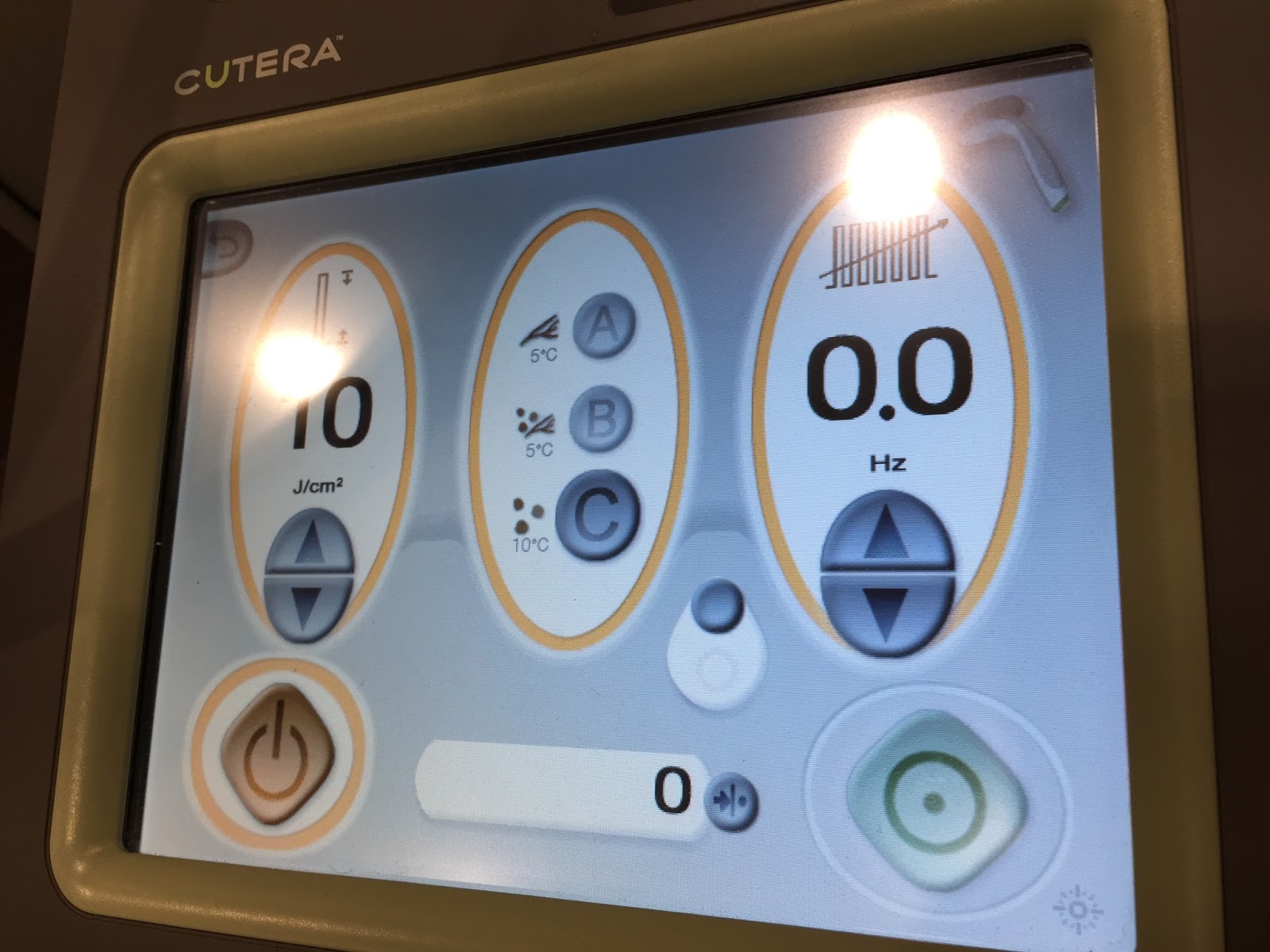


Mechanism of action:
l The heat destroys the red blood cells and the endothelial cells
(cells that form the blood vessels). This can result in permanent destruction,
part destruction or temporary destruction of vessels.
Procedure:
1.
After alcohol wipe, put on
goggles over client’s eyes and operator’s eyes.
2.
Mark treatment areas:
horizontal lines on décolletage, vertical lines on face.
3.
Ensure machine is turned on
(turn the key), pedal in right position.
4.
Do the settings (program and
fluence).
5.
To test it, press the green
button, hold the hand piece low and point it to the floor, count one two, and
on three press the foot pedal and blink eyes at the same time. Find the best
position to place your foot on the pedal.
6.
Use tongue depressor to put gel
on treatment area.
7.
Place hand piece on treatment
area lightly, and press foot pedal to beam.
8.
Ask client to press lips when
doing mouth area.
9.
Use tongue depressor to cover
hair bearing areas and the areas of the nose where part of the hand piece tip
is not in contact with skin.
10.
Maximum 5%overlap.
11.
At the end of treatment, wipe
gel off, put on aftercare products.
Test patching:
1.
Test patch sides of both cheeks,
use program B (target both pigment and vessels). If there’s facial hair have to
shave it first. Wipe test patch areas with alcohol wipe. Mark a white line on each
cheek for face. Drop by 4J for body and mark a cross on chest with the long end
being vertical.
2.
Aim to achieve bit of micro
crusting when they come back in two days’ time. Brown rectangle/blister/prolonged
swelling is overtreatment.
Laser hair removal


Mechanism of action:
l There is selective photothermolysis of melanin.
l Melanin in the hair shaft absorbs light energy which becomes heat
energy.
l The hair must be heated to approximately 70ºc to cause protein
denaturing. Heat radiates from hair shaft to surrounding follicular cells,
causing lysis (death) of some or all of these hair producing cells.
l The hair follicle is unable to grow a hair or produces a slow
growing hair, lighter in colour and smaller in diametre.
Procedure:
1.
Alcohol swab the treatment
area.
2.
Shave off hair with razor.
3.
Mark the treatment borders.
4.
Candela GentleYAG laser
machine: Place the tip of the laser. Do a test cryo on a black spot to see if
it’s spraying properly: should be dispersed evenly, and set treatment
parameters according to skin type & chart. Vectus laser machine by Palomar:
Auto detect or manually select the skin type. If this is client’s first
treatment, drop the settings by 2 joules. Press the start button on screen and
on handle to start.
5.
Treat the treatment area in
snake like motion. Candela GentleYAG laser machine: with the circle crossing
over each other like the Olympic rings. Press the foot pedal to spray. Vectus
laser machine by Palomar: 20% overlaps.
6.
At the end of treatment, spray
on the cooling spray.


